
When people compare crypto casinos and traditional online casinos, the conversation almost always shifts toward payments, anonymity, and withdrawal speeds. This is understandable; it’s the most obvious difference.
However, the real divide isn't found in the deposit method, but in what you can actually play — and why certain formats exist only on specific platforms while being absent from others.
However, the real divide isn't found in the deposit method, but in what you can actually play — and why certain formats exist only on specific platforms while being absent from others.
The Platforms We Are Actually Comparing
When people say "crypto casino" versus "regular online casino", it creates a false impression of two distinct camps. In practice, the distinction is more complex, defined by three key parameters:
A fiat casino with crypto payments remains a strictly regulated entity with restricted mechanics, whereas an offshore crypto casino can experiment and release proprietary formats. It is the regulatory model, not the currency, that determines what is actually possible in-game.
- Currency: Fiat, crypto, or hybrid. Many fiat operators now accept Bitcoin, while crypto platforms support cards. The payment method alone says almost nothing about the available games.
- Regulatory Environment: Strict licenses (UKGC, MGA) versus offshore licenses. This determines which mechanics are permitted: Bonus Buys, adjustable risk, PvP formats, and in-house games.
- Technological Model: Centralized (RNG server), Provably Fair, or On-chain. This is the axis of trust: ranging from third-party auditors to smart contracts.
A fiat casino with crypto payments remains a strictly regulated entity with restricted mechanics, whereas an offshore crypto casino can experiment and release proprietary formats. It is the regulatory model, not the currency, that determines what is actually possible in-game.
Before the Differences: What Both Sides Share
Large offshore crypto casinos offer the same content as regulated European operators. Gates of Olympus, Sweet Bonanza, Book of Dead, and live tables from Evolution Gaming are equally available on both Stake and William Hill. BC Game maintains a catalog of over 10,000 titles; Jackbit offers over 6,000. This is more than most licensed operators in Europe.
However, a shared library does not mean identical access conditions:
However, a shared library does not mean identical access conditions:
- Bonus Buy: Directly purchasing a bonus round has been banned by the UKGC since 2021. On offshore platforms, it is available without restriction, changing the very logic of a session. Instead of waiting dozens of spins for a bonus, you enter it exactly when you decide.
- RTP: Several providers release the same slots in multiple configurations. Versions with a 97–99% return are more common on offshore platforms. Regulated operators generally operate in the 94–96% range.
The Origins of Crypto-Native Genres
To understand the differences more deeply, one must answer: how does a casino prove to a player that a game is fair?
In a traditional online casino, this is done via a certified RNG (Random Number Generator) that is audited. The player sees a certificate but cannot verify a specific round.
The crypto audience grew up with a different logic: verifiable transactions. This gave rise to Provably Fair. The platform publishes a hash of the seed before the game and reveals it after. The player can recalculate the result to ensure the outcome was not altered.
Provably Fair became the foundation for new genres: starting with Dice in 2012, and later expanding to Crash, Mines, and Plinko. These were designed for open verification, rather than as mere variations of traditional slots.
In a traditional online casino, this is done via a certified RNG (Random Number Generator) that is audited. The player sees a certificate but cannot verify a specific round.
The crypto audience grew up with a different logic: verifiable transactions. This gave rise to Provably Fair. The platform publishes a hash of the seed before the game and reveals it after. The player can recalculate the result to ensure the outcome was not altered.
Provably Fair became the foundation for new genres: starting with Dice in 2012, and later expanding to Crash, Mines, and Plinko. These were designed for open verification, rather than as mere variations of traditional slots.

BC Originals catalog
Originals: When the Platform Becomes the Provider
This shift in technology led to the rise of "Originals" — proprietary games developed most often by platforms themselves or by specialized studios, rather than mainstream third-party providers. According to igamingcrypto.io, there are now over 350 Original titles across major crypto platforms.
For a significant portion of the audience, these in-house games are the primary draw. While the "Big Five" — Dice, Plinko, Mines, Limbo, and Keno — have become the industry standard, the catalog often extends to Crash, HiLo, and proprietary versions of Blackjack or Roulette.
The proliferation of these titles is driven by economics: unlike licensed slots, which require royalties on every bet, the platform owns its Originals entirely. By eliminating these third-party fees (which are usually factored into the house edge), operators can shrink their margins and pass that "saved" value back to the player.
The player motivation isn't primarily about provably fair verification — most players never check a hash. The real draw is different: speed, control, and math. A round of Mines or Dice takes 3–5 seconds versus 8–10 for a slot spin. More importantly, games like Dice and Mines put risk decisions in the player's hands — choose your own win probability, set the number of mines, and decide when to cash out. That's a fundamentally different engagement model than watching reels spin. Combined with a 1% house edge versus 4–6% on a typical slot, Originals attract a specific but highly active player segment: high-frequency, volume-driven, and retention-heavy.
Duel deserves special mention as a radical experiment with the Originals format. It brought the house edge in Originals down to zero within established turnover limits.
This isn't just a cosmetic percentage change: at 100% RTP, the player's mathematical expectation is zero until the limit is reached, after which a minimal edge kicks in. The difference between 99% and 100% is essentially the boundary between a game with a built-in negative expectation and a mathematically fair contest with the house.
For a significant portion of the audience, these in-house games are the primary draw. While the "Big Five" — Dice, Plinko, Mines, Limbo, and Keno — have become the industry standard, the catalog often extends to Crash, HiLo, and proprietary versions of Blackjack or Roulette.
The proliferation of these titles is driven by economics: unlike licensed slots, which require royalties on every bet, the platform owns its Originals entirely. By eliminating these third-party fees (which are usually factored into the house edge), operators can shrink their margins and pass that "saved" value back to the player.
The player motivation isn't primarily about provably fair verification — most players never check a hash. The real draw is different: speed, control, and math. A round of Mines or Dice takes 3–5 seconds versus 8–10 for a slot spin. More importantly, games like Dice and Mines put risk decisions in the player's hands — choose your own win probability, set the number of mines, and decide when to cash out. That's a fundamentally different engagement model than watching reels spin. Combined with a 1% house edge versus 4–6% on a typical slot, Originals attract a specific but highly active player segment: high-frequency, volume-driven, and retention-heavy.
Duel deserves special mention as a radical experiment with the Originals format. It brought the house edge in Originals down to zero within established turnover limits.
This isn't just a cosmetic percentage change: at 100% RTP, the player's mathematical expectation is zero until the limit is reached, after which a minimal edge kicks in. The difference between 99% and 100% is essentially the boundary between a game with a built-in negative expectation and a mathematically fair contest with the house.
What Remains in the Offshore Segment
Some crypto-native genres have moved beyond the offshore world. Crash (Aviator) and RNG versions of Plinko have been certified and appeared on licensed platforms. However, they lack Provably Fair tech: the game has the same name and look, but the internal logic is different.
Formats with adjustable risk and high customization usually remain outside regulated markets:
Formats with adjustable risk and high customization usually remain outside regulated markets:
- Dice with Adjustable Probability: The player chooses their own win chance while the house edge remains mathematically fixed.
- Mines: The player sets the number of mines, effectively controlling the session's volatility.
- Case Battles: A PvP format derived from the virtual item economy where players compete by opening "cases." These models are nearly absent in regulated markets due to legal uncertainty regarding virtual assets and peer-to-peer licensing.
- Wager Races: Competitive leaderboards with large prize pools. While technically possible anywhere, their scale and bonus structures are significantly limited in strictly regulated jurisdictions.
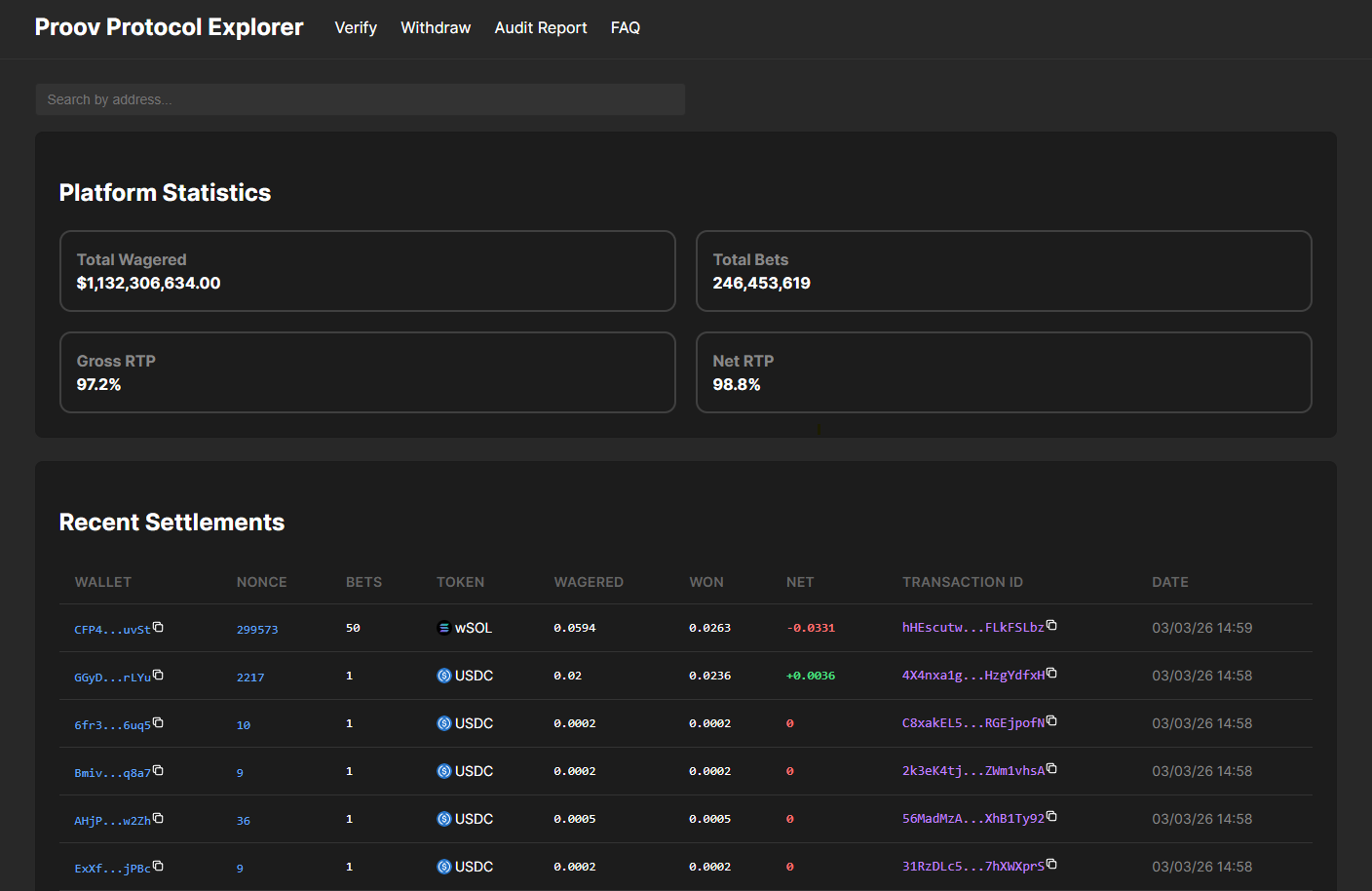
Proov Network - randomness verification protocol. Built on Solana, used by Luck(.)io
On-chain Casinos: When Code Becomes the Operator
On-chain casinos go beyond standard crypto platforms: the entire betting logic, outcome generation, and payouts are executed directly by smart contracts on the blockchain. There is no central server and no operator as a middleman — the result cannot be manually changed. Among the most notable examples operating in this space: Luck(.)io (Solana-based, uses Proov Network for randomness verification).
Most on-chain studios build their own games from scratch, without access to the traditional B2B game studio ecosystem (Pragmatic Play, Evolution, BGaming) that regulated and offshore casinos rely on. The result is a deliberately minimal catalog: mathematically clean, verifiable, but limited in variety by design.
Because of blockchain limitations and the need for open verification, the variety is smaller: typically Dice, Coin Flip, Crash, Mines, and Plinko with minimal graphics. Complex slots are theoretically possible but expensive to implement due to high "gas" fees and UX hurdles.
The main difference from Provably Fair platforms is that cheating is physically impossible. Integrity is guaranteed by architecture, not by trust in an operator or a hash. The trade-off is more complex onboarding and gas fees, but this model represents the vanguard of "trust through transparency."
Most on-chain studios build their own games from scratch, without access to the traditional B2B game studio ecosystem (Pragmatic Play, Evolution, BGaming) that regulated and offshore casinos rely on. The result is a deliberately minimal catalog: mathematically clean, verifiable, but limited in variety by design.
Because of blockchain limitations and the need for open verification, the variety is smaller: typically Dice, Coin Flip, Crash, Mines, and Plinko with minimal graphics. Complex slots are theoretically possible but expensive to implement due to high "gas" fees and UX hurdles.
The main difference from Provably Fair platforms is that cheating is physically impossible. Integrity is guaranteed by architecture, not by trust in an operator or a hash. The trade-off is more complex onboarding and gas fees, but this model represents the vanguard of "trust through transparency."
Summary
Game content differs between offshore crypto casinos and regulated platforms, not because of the payment method.
The majority of the catalog — slots, live games, table games — is identical. The difference lies in access conditions, RTP configurations, and permitted mechanics.
Provably Fair provided the foundation for new genres. Originals allowed platforms to manage game economics directly. High-risk, customizable, and PvP formats flourished where the regulatory environment allowed for flexibility.
The majority of the catalog — slots, live games, table games — is identical. The difference lies in access conditions, RTP configurations, and permitted mechanics.
Provably Fair provided the foundation for new genres. Originals allowed platforms to manage game economics directly. High-risk, customizable, and PvP formats flourished where the regulatory environment allowed for flexibility.
Launching Your Own Crypto Casino Made Simple
For operators looking to enter this space, the infrastructure question is usually what slows things down most.
Maincard Sandbox lets operators quickly launch crypto casinos, including Originals, with minimal technical hassle. From full website design (templates or custom themes) and hosting to payments, KYC, responsible gaming, and integrated game hubs — the infrastructure is ready to go. 24/7 support and a dedicated account manager help keep operations smooth, all under a single gaming license.
Maincard Sandbox lets operators quickly launch crypto casinos, including Originals, with minimal technical hassle. From full website design (templates or custom themes) and hosting to payments, KYC, responsible gaming, and integrated game hubs — the infrastructure is ready to go. 24/7 support and a dedicated account manager help keep operations smooth, all under a single gaming license.